Why the law blocked prosecution
Statute of Limitations (SOL)
In 1977 (when Renee was killed), Connecticut law set time limits for prosecuting certain crimes unless they were classified as capital or life-imprisonment offenses.
• Murder carried no time limit.
• But manslaughter which might have been the only charge possible due to the suspect’s age had a 5-year limit at that time.
If prosecutors believed they couldn’t charge “murder” because of the juvenile’s age or evidence limitations, the statute of limitations likely expired by the early 1980s.
Bottom line: If the clock expired before the law changed, the state can’t reopen it now — no matter how strong the evidence.
Age of the perpetrator
The killer was reportedly 13 years old — under 14 — at the time of the crime.
Under Connecticut law in 1977:
• Children under 14 were presumed incapable of forming criminal intent (“infancy defense”).
• They could not be charged as adults, and the juvenile court only had jurisdiction up to a certain age (often 16–18).
So even if police solved it years later, the courts lost jurisdiction long ago because the offender aged out of the juvenile system and could never be tried as an adult.
Bottom line: The state literally had no legal mechanism left to prosecute him not because he was innocent, but because the law didn’t allow it.
About Renee’s Law
• Renee’s Law is a proposed Connecticut initiative designed to reform outdated legal barriers that prevent accountability in cases involving child victims.
• It seeks to fix the laws that failed Renee and ensure no family ever faces this kind of injustice again.
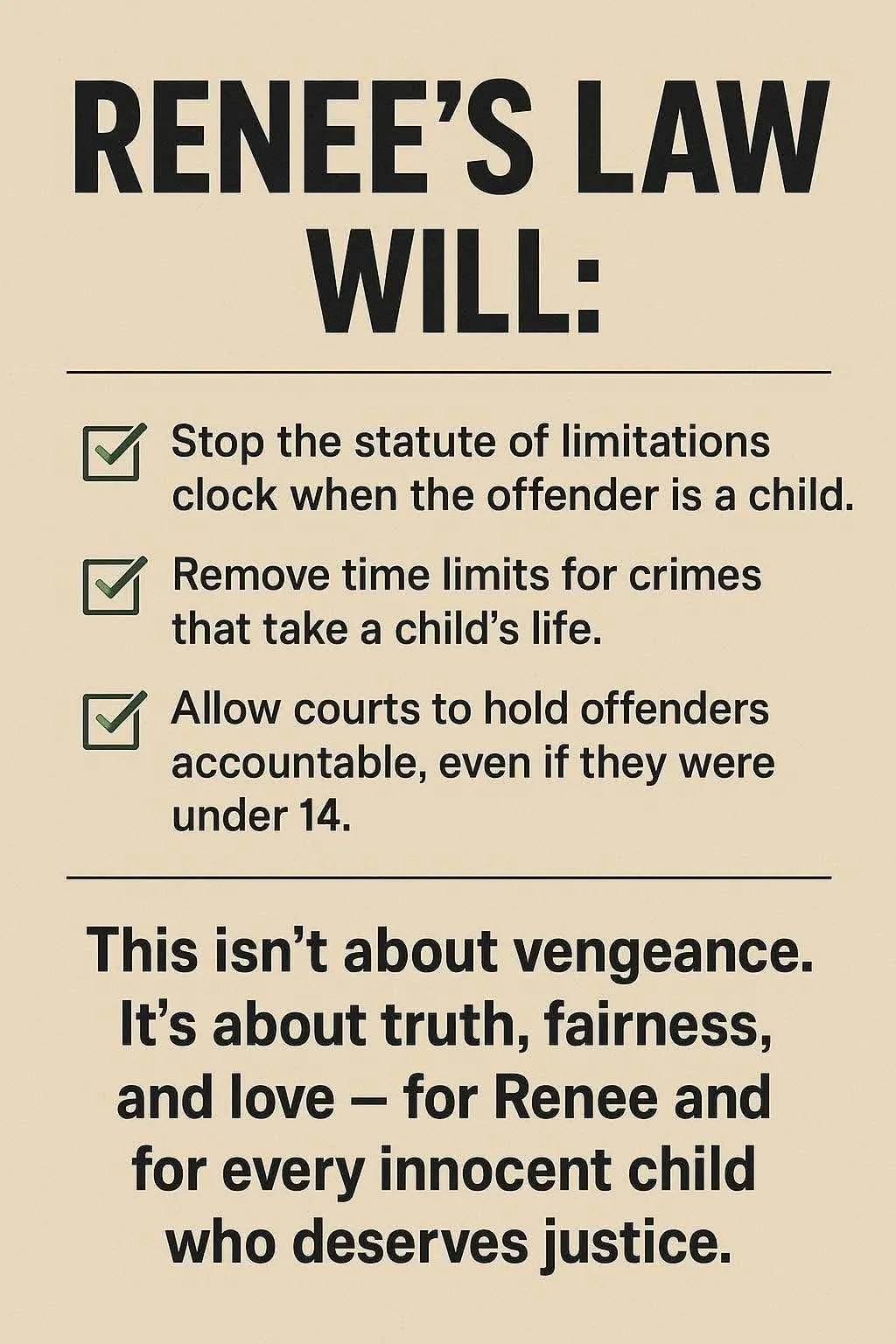
•The law would do three essential things:
1. Pause the statute of limitations when the offender is a juvenile.
2. Eliminate time limits for crimes that take a child’s life.
3. Allow courts to consider accountability even when the offender was under 14 at the time of the offense.
Goals:
Toll the Statute of Limitations
Pause the clock until the offender turns 18 or until new evidence (e.g., DNA) is found.
Amend Conn. Gen. Stat. § 54-193 to specify tolling for juvenile offenders in cases involving a minor victim.
2. Remove Time Limits for Homicides of Minor Victims
No limitation period for any crime resulting in the death of a minor, regardless of offender age.
3. Modernize the “Infancy Defense”
Allow courts to hold capacity hearings for ages 12–14 in homicide cases instead of automatic immunity.
4. Preserve Limited Jurisdiction
Authorize post-juvenile proceedings when new evidence arises after the offender reaches adulthood.